Round 11, Richies vs. Poories
This is the sort of piece I'd usually save for Midwest Mindset, but I'd rather not detract from the brewing Moody controversy (as I like to hype it), so it falls here instead. Face front, True Believers!
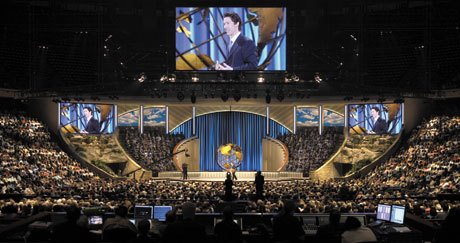
Time Magazine ran a really great cover story last week titled "Does God Want You To Be Rich?" There were interviews with Joel Osteen, Rick Warren and Ron Sider, and some non-pastor types as well. Instead of copying and pasting chunks of the article here, I thought I'd just throw out a few quotes from the piece to give you a general idea of what it contains.
******************
"I think God wants us to be prosperous. I think he wants us to be happy. I think he wants us to enjoy our lives. I don't think I'd say God wants us to be rich." -- Joel Osteen, megapastor and author of Your Best Life Now
"Prosperity Lite is everywhere in Christian culture. Go into any Christian bookstore, and see what they're offering." Rev. Chappell Temple, Methodist minister
"Who would want something where you're miserable, broke and ugly and you have to muddle through until you get to heaven? ....I believe God wants to give us nice things" -- Joyce Meyer, television preacher, author of too many books to mention
"They have neglected the texts about the danger of riches. Prosperity Gospel Lite is one of the most powerful forms of neglect of the poor." -- Ron Sider, professor Eastern University, author of Rich Christians in an Age of Hunger
"God wants you to own land. The entire Old Testament is all about land. Land represents that God is with you and God has blessed you." -- Kirbyjon Caldwell, minister of the largest United Methodist congregation in the U.S.
"The idea that God wants everyone to be wealthy? Baloney. It's creating a false idol. You don't measure your self-worth by your net-worth. I can show you millions of faithful followers of Christ who live in poverty. Why isn't everyone in the church a millionaire?" -- Rick Warren, megapastor and author of The Purpose Driven Life
"We need to renounce the false gospel of wealth and health--it is a disease of our American culture; it is not a solution or answer to life's problems." -- Ben Witherington, New Testament theologian, Asbury Seminary
"Jesus' words about money don't make us very comfortable, and people don't want to hear about it." -- Collin Hansen, editor Christianity Today
******************
The article is a doozy. But it's a topic that deserves the cover story treatment (and deserves to be read, too). It points out that many Prosperity churches are heavily involved in charity giving. And that's great. But God never commanded a potential disciple to give generously to charity and follow me. Furthermore, a telling statistic from the article is that 31% of Americans believe that if you give money to God, he will in turn bless you with even more money, as if God's greatest blessing this side of heaven is greater wealth.
However, it was that last quote from Collin Hansen that interested me most, because of how true it is. The article continues to quote a Princeton sociologist who says that "There has long been a taboo on talking candidly about money" in the U.S. church. I'm a testament to that. The only money talks I heard growing up were concerned with tithing. Give to God what's his, pre-taxes, and figure out the rest for yourself. For some reason, pastors are comfortable preaching about sexual mores and time management and even sometimes politics. But money? No way.
After half a century of over-emphasis on eternal destiny, at the cost of social inequality, evangelicals are finally wising up to the whole Gospel of salvation and liberation, both in the afterlife and here on earth. But what is it about finances and material wealth that make them such uncomfortable topics? Again, I'd go back to the Hansen quote: Jesus' words about money don't make us very comfortable.
And there's the rub. Its nice to think about saving babies and taking purity pledges and spending more time with our families. These are clear-cut issues of justice and responsibility and righteousness that evangelicals can all agree on. But no one agrees about money. And when we do agree, it's still an uncomfortable subject (unless, you're one of the so-called experts that's written a book or something, hence, the quotes). I don't like mentioning it, but when I spent a year with AmeriCorps in Montana, I was too stubborn to ask my parents for help every now and then, and ended racking up a hefty credit card bill to pay for groceries and travel money (I drove somewhere new in Montana just about every weekend, and while gas prices weren't so bad two years ago, Montana is a big state). It's embarrassing to admit, especially because of my general hatred of credit card companies these days (also due to a fantastic Frontline about the industry), but it's what I did, and I can't undo it. I can only pay it off.
But is that the only reason evangelicals don't like to talk about money? Because we're embarrassed by our past financial transgressions? Or because we disagree on how to handle our individual finances? Is it because Christ's sayings are hard? Or is it because they're sometimes confusing? Has it always been this way? Or is this a uniquely American taboo? If you're so inclined, what do you think?