Why we type, at least part of the time. Mostly though, it's just for giggles.
If I'm up for it, alot is going to be said this year. And throughout all the bitching, and all the snark, and all the times I try to be funny or ironic or smarter than the world, I thought it might be nice to explain why I care about these things I type about. Why I care about elections and the elected and the function and responsibilities of the electors. Essentially, why I give a crap.
If there's one thing I want people to take away from whatever BS goes up on this blog, I guess it's this:
There is a thing called government, and it is a tool -- a means to an end. Government isn't inherently good, and government isn't inherently evil. It's a result of Evil to be sure. We wouldn't need it were we still living in the paradise of Eden. But it's a result of Good, too. We wouldn't have created it unless we saw in it some temporary relief from lawlessness and disorder. A democratic government is only as good as its people. And that's a plain fact. We get out of government what we put into it.
To wit, the government is the people. It is chosen by us, in a remarkable process of the popular vote (well, in most cases). It acts for us, legislating and executing laws on our behalf. And in the end, it is answerable only to the people. We are it and it is us. And when we grow tired of it, we tear it down and elect a new one, without a shot being fired. This is what we do every presidential election. We either confirm the status quo or reject it by brining in someone new. A bloodless revolution every four years.
My view of government has been evolving in fits and spurts for some time now. With all this rhetoric, it's easy to assume I've adopted a populist point of view. And maybe you'd be right. But mostly you'd be wrong. My view of government has less to do with the Roosevelts of the world, and more to do with the Calvins and Luthers. It's Judeo-Christian to be sure, but it's Reformed as well. My view of government is one that says the people have a right and a responsibility to stand up to the Great Powers of the world and say, "Sit down and shuttup. You are not our authorities, our representatives or our judges. We walk with you as long as you walk with us. The only power you have is what we give you. And should you cross us, we will tear you a new one. Then doodle funny little cartoons about how stupid you are. Because seriously. You are stupid."
Essentially, the purpose of government is to stand against tyranny -- in any form. 250 years ago, that meant the tyranny of Mother England. Unrepresented in Parliament, the people of the American colonies revolted. Today that might mean the tyranny of the few over the many. The tyrannies of excessive wealth and corporate greed, consolidated media and big business, corporations who tell us how to live our lives but who in no way represent us or our best interests. If the Founders had seen what unchecked business could do to their nation, they'd be aghast, Jefferson and Hamilton alike (for all their differences).
Anyone who knew me five or six years ago would have thought I was interested in theology mostly, and maybe a few other things from time to time. And theology still has a strong hold over me. But my reasons for asking the "Big Questions" have shifted somewhat. In the day, I asked the questions out of curiosity. Not enough people were asking them, so I thought, " Why not me?"
Now I ask the questions out of a desire for proper praxis. I want to know how to live rightly in 21st century America. Also, I want to know if that's even a possibility. And living rightly, in a political sense, brings up different questions than "Does God know the future?" or "Is there a magic way to read the Bible so that we all agree on every issue?" (And don't try to kid yourself; if you live and work in America, you're already a politically active person. The act of owning property or goods or simply buying milk and where you buy it are all political acts.)
And I want to know what it means -- both politically and theologically -- what it means to own land, and what it means to purchase items others have made, and what it means to buy milk at Kroger rather than IGA, or 2% rather than skim, or organic rather than conventional. And if you don't think your theology informs all those decisions, then it's time to rethink your theology.
Of course, exploring these issues brings up loads of hypocrisy. But that's only human. We believe in things so deeply at times, that it's hard to bring our praxis (our actions) up to speed with our doxis (our beliefs) in the midst of a fallen world. But just because it's a hard thing, doesn't mean it's a futile thing. We try because we must. We try because we're people, because we don't get things right the first time or the second time or the third time. Because we know that even though we may never get things right, we learn something new and something powerful and something useful every time we fail. And we become better people for it.
And yes. The process of reforming our government seems like an impossible task sometimes; but that doesn't give us the right to sit back and let someone else take care of it. This little website, in its own small, insignificant way, is my own small, insignificant voice. It is one of many small, insignificant political acts, that I hope add up to something not so small or insignificant. It's my way of saying, "I have a voice, weak though it may be. And it counts for something."
Over the next 10 months, remember that. And remember this, too: Your government functions on your behalf for as long as you would have it. And then, every four years, a revolution happens. Picking a new president isn't a political game, it is the responsibility of the polis, who in our country consent to be governed by others -- others who owe no loyalty to any other nation or institution or corporation, but do what they do for the express purpose of what's right for all of America. In a perfect world, we wouldn't need government....
But you know the rest.
Monday, January 21, 2008
A Sort-Of Framework: What It Means for Me to Blog in 2008

Thursday, October 25, 2007
Just in time for Halloween!

It's all over Blog City! Harry Potter is Jesus and Dumbledoor likes dudes!
Blog City was abuzz this week with news from J.K. Rowling's world book tour. Firstly, she finally came clean about how the Potter Boy was basically a Christ-figure, and that she'd been hesitant to point out the parallels for fear of giving away the end to Book 7. Oops, spoiler alert! Harry dies! Harry comes back to life! Harry marries the Weasley girl! Just like Jesus! And secondly (also, apparently just like Jesus), Albus Dumbledore is very much gay. Just when she might finally have the evangelicals on her side, Rowling springs this on 'em. I don't know how much Dumbledore's sexual preference really matters, other than to say that his character was terribly miscast in the films now. Yes, Sir Ian McKellen, you were robbed.
You were robbed!
The End
Friday, July 20, 2007
Vengeance and Harry Potter

Its only a couple of hours before Deathly Hallows hits the stores...and I already have a beef. Actually, it's been stewing for about two years now. Alright, J.K., let's have at it.
Book 6 has been sitting on the floor next to my bed for about six weeks now, collecting dust. I figured I'd pop it open sometime before the 20th and get myself ready for book 7. But there it sits. Where's the excitement I had for books 5 and 6? Where's the animal rabidity I unearthed ripping through books 1-4? I've been wondering some about that and doing some thinking.
And this is what I thought. This series rests on one central fact -- Harry wants revenge. In the first three books, Harry and his clan were so enamored with wonder and discovery that the vengeance aspect of the series took a back seat. At their core, these Potter books are about exploration -- discovery of self and wonder of world. All throughout volumes 1-5 it was clear that these books were wonderful examples of sacrifice and love.
But somewhere along the line, things changed. Book 5 was the first in the series I read as it came out. I loved it. But Sirius Black's death near the end introduced a new tone to the series, or perhaps more accurately, brought to light a shadowy undercurrent that had been running through the books all along. For Harry to "win", he needed vengeance. He needed revenge against Voldemort for killing his parents, his uncle and many others. With the death of Dumbledoor in book 6, this need for vengeance only became more acute. By the end of Half-Blood Prince, the only avenue left for Harry was to leave school and focus his efforts on ending Voldemort once and for all.
And there's my worry. That the Potter books, such a miraculous example of sacrificial love, are going to degenerate into a simple quest for vengeance. Did Harry's parents die to give Harry life? Or did they sacrifice themselves simply because Harry was the only one who could defeat (and kill) Voldemort? And what's the distinction?
When using Harry's mother (and her sacrifice) as an example of Christ's sacrificial love, the answer leans towards the former. But if Harry's quest for redemption can only succeed through the application of vengeance, the whole "Christian defense" of the Potter books crumbles. Imagine if Christ died so that his followers would rise up in revenge against a hypocritical religious establishment and a secular political order. What if his death had nothing to do with forgiveness or remission, and was simply the first spark in a long war for retribution through the application of violence and war?
If that sounds absurd, then the potential for a violent book 7 should scare us. Some of Christ's followers no doubt would have wanted to return violence for violence in response to Christ's death, just as Harry wishes violence upon Voldemort. But the problem they struggled with is the problem we all deal with on a daily basis (and more acutely since 9/11). Namely, that vengeance is not Christian. The concept of revenge should be as foreign to the Christ-follower as greed or adultery. And the thirst for it is anathema to the spirit of the Christian faith.
Love your enemies. Pray for them. Turn the other cheek. Go the extra mile. Bust most importantly:
Vengeance is mine, thus saith the LORD.
That's not to say that old Voldey deserves a pat on the back and a big bowl of ice cream. While vengeance is God's, justice is something the Christian should be supremely concerned with. Not only justice for the poor and oppressed, but justice upon those who abuse their wealth and power. Justice is to be served on both the oppressors and the oppressed. Thieves, warmongers and murderers deserve justice, too.
And that's where the arguments start. That's where the trouble lies. Can violence be used as a means towards justice? Unjust states have been violently overthrown with both great and terrible results. But as Christ-followers we have to ask if it's ever worth it? Can the ends justify the means?
But now we're way off topic. Because justice is not vengeance. These are two very different concepts, with very different outcomes. Is justice served if Harry kills Voldemort? Perhaps. Most certainly, vengeance is served. Yet there's this inescapable idea that we can't have both. In dispensing justice, it's difficult for the aggrieved party to accurately mete out a suitable punishment, because in most cases, it's difficult for them to be rational adjudicators of justice. Ideally, judges are meant to be impartial arbiters of confiscation, correction and reparation. Maybe that's not entirely possible, but it's important to strive for it, and the aggrieved will have the hardest of times doing so.
Justice restores things to their proper order and balance. That's its purpose, and it's a righteous concept. Vengeance, while not its stark opposite, is still diametrically opposed to justice. It is the (irrational?) use of force in a state of rage to punish a wrong with an even greater wrong. It does not concern itself with restoration or recompense. Only revenge.
And that's the difference. The world of Harry Potter began in the last days of the roaring 90s. But it ends in a post-9/11 world, where we ask questions like "what is justice?" and "what is vengeance?" on a daily basis.
I hope book 7 has Harry deal with these issues in a frank and startling way. I hope he wrestles with what it means to kill or be killed in his final confrontation with Voldemort. War is hell. There's death and blood and guts and vomit. When you move from restorative justice to singular vengeance, you have to deal with the consequences in all their muddy glory.
And in my heart of hearts, I hope there's way for Harry to restore things to their rightful place without resorting to vengeance. It's the difference between a Mel Gibson war movie and Terrence Malik one. There ought to be a struggle in Harry Potter, as he grows from an adolescent into a young man, and deals with how far he's willing to go in his quest to restore the right things to their proper places.
But I fear that won't happen. Miss Rowling has been leading us down this vengeful path for two books now (maybe more), and I fear it's simply too late to turn back. There were signs in books 4 and 5, but we had invested so much in the character by that time, that it was hard to recognize the warning signs. It wasn't until halfway through book 6 that I finally realized where this was going. It all ends in revenge. It all ends in a final confrontation, where Harry will have the opportunity to seek vengeance upon those who have wronged him. And most likely, he will succeed.
But what then? In reality, life doesn't end after book 7. It doesn't end at age 18. In reality, killing killers doesn't bring resolution, it just eliminates the danger of them killing again. In reality, bombs dropped in Afghanistan fail to bring closure to a grieving nation. Instead, they bring even greater violence, leaving oppression and corruption and unrelenting guilt in their wake.
But Harry (most likely) will never have to deal with that. Because his life ends, whether he dies or not, on July 21st. He'll never have to come to grips with the fact that he's ended the lives of other human people, actual human beings, and that their deaths will never bring back his parents, or his friends, or his mentor. No one will have to deal with the aftermath, six years later, because that portion of his life will never be written.
What kind of message is that? Mission Accomplished? Not one of self-sacrifice and unfailing love, but one of hatred and rage and ignorance. Because in Harry's world, there are no long-term consequences for his actions. There's no long term anythings.
And the sad thing is, we know that's bullshit. It's just simply not true. We see it for the lie it is every night we watch the news, or open the paper, or surf the internet. There are always consequences. There is rarely closure.
And there is always more violence.
Tuesday, February 13, 2007
Note To Ted Haggard: Sack Up, Already

First off, I have to get this out of the way. I love Ted Haggard. It wasn't always this way. But since the whole brouhaha in November, I have had serious feelings of love and affection for this man. He loves God. He struggles. He messes things up. What's not to love, exactly?
That being said, I am seriously disappointed with this man I love -- in Christian love, both the agape and philial varieties -- because of his supposed three week turnaround from confused sexual being to raging heterosexual. You heard me right: Ted Haggard says he's completely hetero after three weeks of counseling. Restoration, indeed! Hallelujah!
Except not. Another disclaimer: in this post I will not argue the point that counseling a body/mind from homosexuality to heterosexuality is/is not possible. Instead I'll defer to the Kinsey scale and chalk up Haggard's behavior to the distinct probability that he lies within the 80% of the population that is neither exclusively straight or exclusively gay. Using that logic, it's absurd to force the man to pick a side and draw up battle lines. Let Haggard be Haggard. And not either Will Truman or Magnum P.I. There's some middle ground here that we ought not to ignore.
The Haggard camp doesn't see it that way. And that's a sad fact. One of the pastors who oversaw Haggard "recovery" had this to say: "He is completely heterosexual. That is something he discovered. It was the acting-out situations where things took place. It wasn't a constant thing."
So according to Haggard's boys, his dalliance with Mike Jones was "acting-out." In other words, his gay-ness wasn't 24/7; it was a outlet he pursued to deal with certain problems. No word on what those problems were -- the drug habit is a good guess (though Haggard never admitted to using), and marital problems could be implied from the statement, too. But in the end it doesn't matter. Because it's not true.
Andrew Sullivan of the Atlantic Online points out the tragedy of it all -- that Haggard, in denying his bisexual tendencies, is only making himself sicker. Talk about hitting the nail on the head. This doesn't mean that Ted has to have sex with guys to fulfill himself as a human being. No. What it does mean is this: Haggard needs to admit to himself that he likes guys on occasion, and that it's part of him that won't ever go away. But because of his beliefs, he will deny that urge and focus his energies elsewhere. It's the same thing millions of Christians do every year during the season of Lent. It's the same thing priests (well, most of them) and nuns have done for centuries. It's the same thing a married man does when he sees a good-looking woman that isn't his wife. It's done every day. That doesn't make it easy. But it does make it possible.
By refusing to accept the truth, and claiming he's 100% all woman-lovin', Haggard only makes it harder on himself to move on and minister to others. Hopefully, he comes to his senses and realizes that no amount of calling an oak tree a fire hydrant makes it a fire hydrant. Yet no matter what, I'll keep on loving him. Because my love for Haggard is agape, and my affection is hesed. And it doesn't go away because he's a toolbag.
Lucky him.
Friday, February 09, 2007
Caught Up

Musings on sticking around for the main event
I was thinking some about the Rapture today; not the band but the eschatological event, and I was kind of hoping that if there is an actual Rapture, maybe I could skip it.
It's not that I don't want to meet Jesus in the clouds, that does sound fairly awesome, but moreso that it would be interesting to live in a world where there were no Christians or Christian bookstores or Christian bracelets or even Christian ocelots. Think of all the things you could do if you were the last Christian on earth:
- You could have a Christian band, and you'd be the only Christian band on earth. You could cover every song by DC Talk and the Newsboys and Phillips, Craig and Dean and Zao and no would could tell you not to because they'd all be in heaven and you could tell them to shut the hell and they'd have to obey because they couldn't talk back.
- You could be on all the talk shows and talking heads shows as the last living expert on Christianity. You could probably run for governor of Alabama or North Dakota on the Christian ticket and still stand a good chance of winning. You could run for president and most likely lose but still garner enough votes to find yourself in a cabinet position. Mostly, politics would be a hoot, at least for those first three-and-a-half years.
- Then there's the Tribulation. Okay, that might suck. But, if I played my cards right, I might be able to land myself a spot on the Tribulation Force, and get to shoot rocket-propelled grenades at the Anti-Christ, who would be my good buddy from the old cabinet days. He's most likely a dick anyways, so the whole rocket thing might not be so bad.
- Two words: Bible Smuggler. I could be the next Brother Andrew!
- That's all I got. Except maybe I would push for Armageddon to happen on the moon, because that does sound pretty sweet. Moon Wars!
Sunday, September 24, 2006
The Gospel of Prosperity. Now With Twice the Wealth!
Round 11, Richies vs. Poories
This is the sort of piece I'd usually save for Midwest Mindset, but I'd rather not detract from the brewing Moody controversy (as I like to hype it), so it falls here instead. Face front, True Believers!
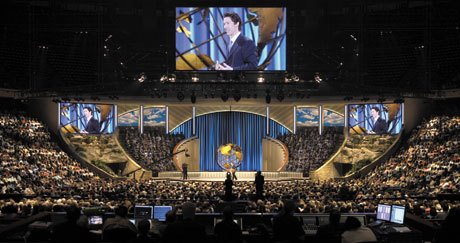
Time Magazine ran a really great cover story last week titled "Does God Want You To Be Rich?" There were interviews with Joel Osteen, Rick Warren and Ron Sider, and some non-pastor types as well. Instead of copying and pasting chunks of the article here, I thought I'd just throw out a few quotes from the piece to give you a general idea of what it contains.
******************
"I think God wants us to be prosperous. I think he wants us to be happy. I think he wants us to enjoy our lives. I don't think I'd say God wants us to be rich." -- Joel Osteen, megapastor and author of Your Best Life Now
"Prosperity Lite is everywhere in Christian culture. Go into any Christian bookstore, and see what they're offering." Rev. Chappell Temple, Methodist minister
"Who would want something where you're miserable, broke and ugly and you have to muddle through until you get to heaven? ....I believe God wants to give us nice things" -- Joyce Meyer, television preacher, author of too many books to mention
"They have neglected the texts about the danger of riches. Prosperity Gospel Lite is one of the most powerful forms of neglect of the poor." -- Ron Sider, professor Eastern University, author of Rich Christians in an Age of Hunger
"God wants you to own land. The entire Old Testament is all about land. Land represents that God is with you and God has blessed you." -- Kirbyjon Caldwell, minister of the largest United Methodist congregation in the U.S.
"The idea that God wants everyone to be wealthy? Baloney. It's creating a false idol. You don't measure your self-worth by your net-worth. I can show you millions of faithful followers of Christ who live in poverty. Why isn't everyone in the church a millionaire?" -- Rick Warren, megapastor and author of The Purpose Driven Life
"We need to renounce the false gospel of wealth and health--it is a disease of our American culture; it is not a solution or answer to life's problems." -- Ben Witherington, New Testament theologian, Asbury Seminary
"Jesus' words about money don't make us very comfortable, and people don't want to hear about it." -- Collin Hansen, editor Christianity Today
******************
The article is a doozy. But it's a topic that deserves the cover story treatment (and deserves to be read, too). It points out that many Prosperity churches are heavily involved in charity giving. And that's great. But God never commanded a potential disciple to give generously to charity and follow me. Furthermore, a telling statistic from the article is that 31% of Americans believe that if you give money to God, he will in turn bless you with even more money, as if God's greatest blessing this side of heaven is greater wealth.
However, it was that last quote from Collin Hansen that interested me most, because of how true it is. The article continues to quote a Princeton sociologist who says that "There has long been a taboo on talking candidly about money" in the U.S. church. I'm a testament to that. The only money talks I heard growing up were concerned with tithing. Give to God what's his, pre-taxes, and figure out the rest for yourself. For some reason, pastors are comfortable preaching about sexual mores and time management and even sometimes politics. But money? No way.
After half a century of over-emphasis on eternal destiny, at the cost of social inequality, evangelicals are finally wising up to the whole Gospel of salvation and liberation, both in the afterlife and here on earth. But what is it about finances and material wealth that make them such uncomfortable topics? Again, I'd go back to the Hansen quote: Jesus' words about money don't make us very comfortable.
And there's the rub. Its nice to think about saving babies and taking purity pledges and spending more time with our families. These are clear-cut issues of justice and responsibility and righteousness that evangelicals can all agree on. But no one agrees about money. And when we do agree, it's still an uncomfortable subject (unless, you're one of the so-called experts that's written a book or something, hence, the quotes). I don't like mentioning it, but when I spent a year with AmeriCorps in Montana, I was too stubborn to ask my parents for help every now and then, and ended racking up a hefty credit card bill to pay for groceries and travel money (I drove somewhere new in Montana just about every weekend, and while gas prices weren't so bad two years ago, Montana is a big state). It's embarrassing to admit, especially because of my general hatred of credit card companies these days (also due to a fantastic Frontline about the industry), but it's what I did, and I can't undo it. I can only pay it off.
But is that the only reason evangelicals don't like to talk about money? Because we're embarrassed by our past financial transgressions? Or because we disagree on how to handle our individual finances? Is it because Christ's sayings are hard? Or is it because they're sometimes confusing? Has it always been this way? Or is this a uniquely American taboo? If you're so inclined, what do you think?